- Author Margarete Zimmermann
- Date December 2025
In 1973, Lothar Wolleh portrayed Sonia Delaunay in Paris. The print on linen was later enriched by the grande dame of classical modernism through a painterly intervention, transforming the photographic portrait into a work partly executed by her own hand.
In 1973726 she was contacted by the young German photographer Lothar Wolleh, a representative of experimental portrait photography. In 1950 he had been abducted from West Berlin to the Soviet Union as an alleged spy and sentenced there to six years of forced labor in the notorious Vorkuta Gulag. In 1956 he returned to Berlin prematurely thanks to a repatriation initiative for German prisoners of war initiated by Konrad Adenauer.727
From 1967 onward Wolleh launched his major project, a series of 109 portraits of international avant-garde artists. Using his Hasselblad camera, he produced photographs that sought to “bring out the specific qualities of each artist’s work,”728 portraying figures such as Joseph Beuys, Dorothy Iannone, Gerhard Richter, Jadwiga Maziarska, and Henry Moore, in which light as well as reflections and mirrorings play an important role.
This is also the case in the square black-and-white portrait of Sonia Delaunay in her Paris apartment, framed by the black border of the negative. Slightly shifted to the left of the image’s center, the artist sits on a modern chair alone in an empty room, the entrance hall of her apartment, dressed in her “uniform” of the 1970s: a dark Chanel suit that further.
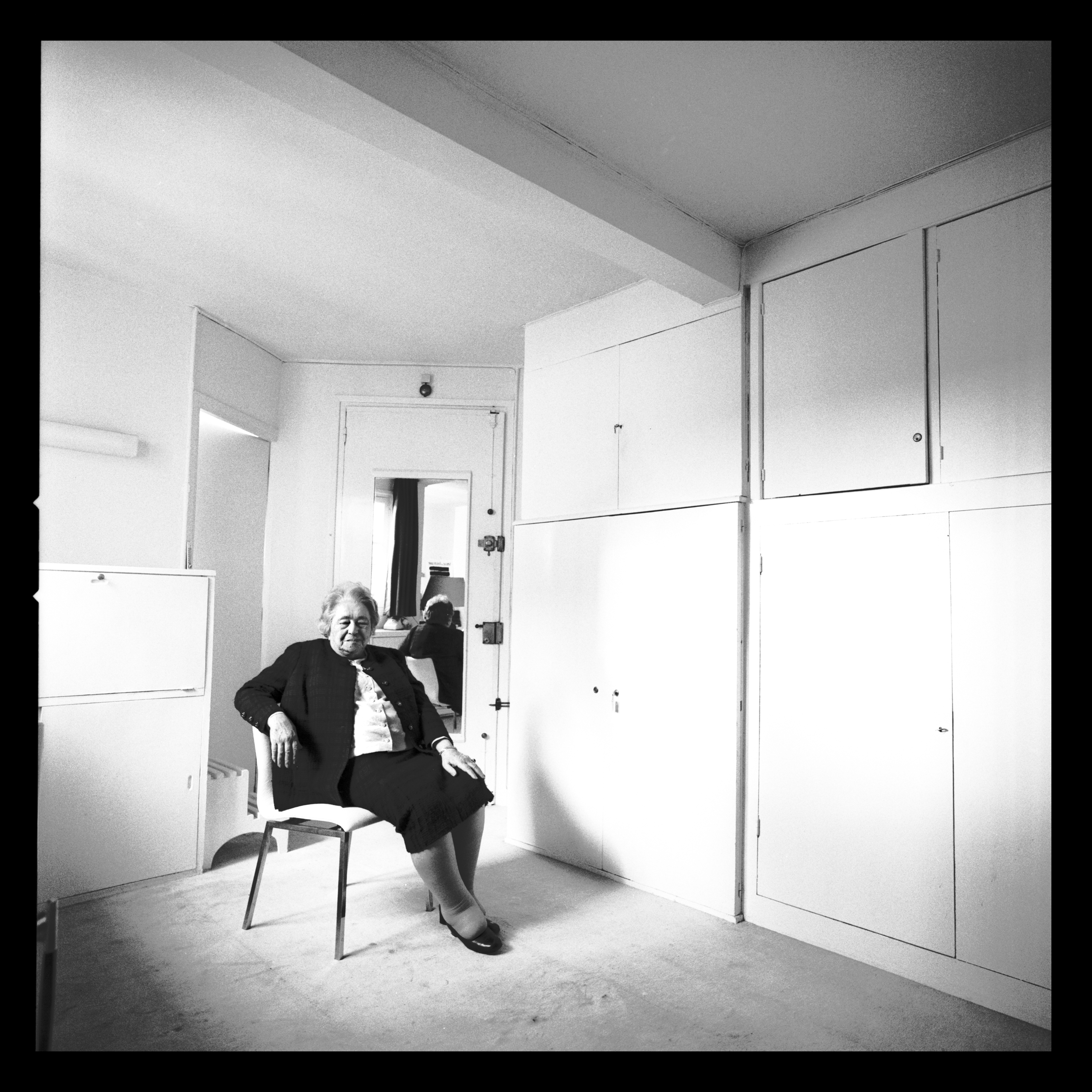
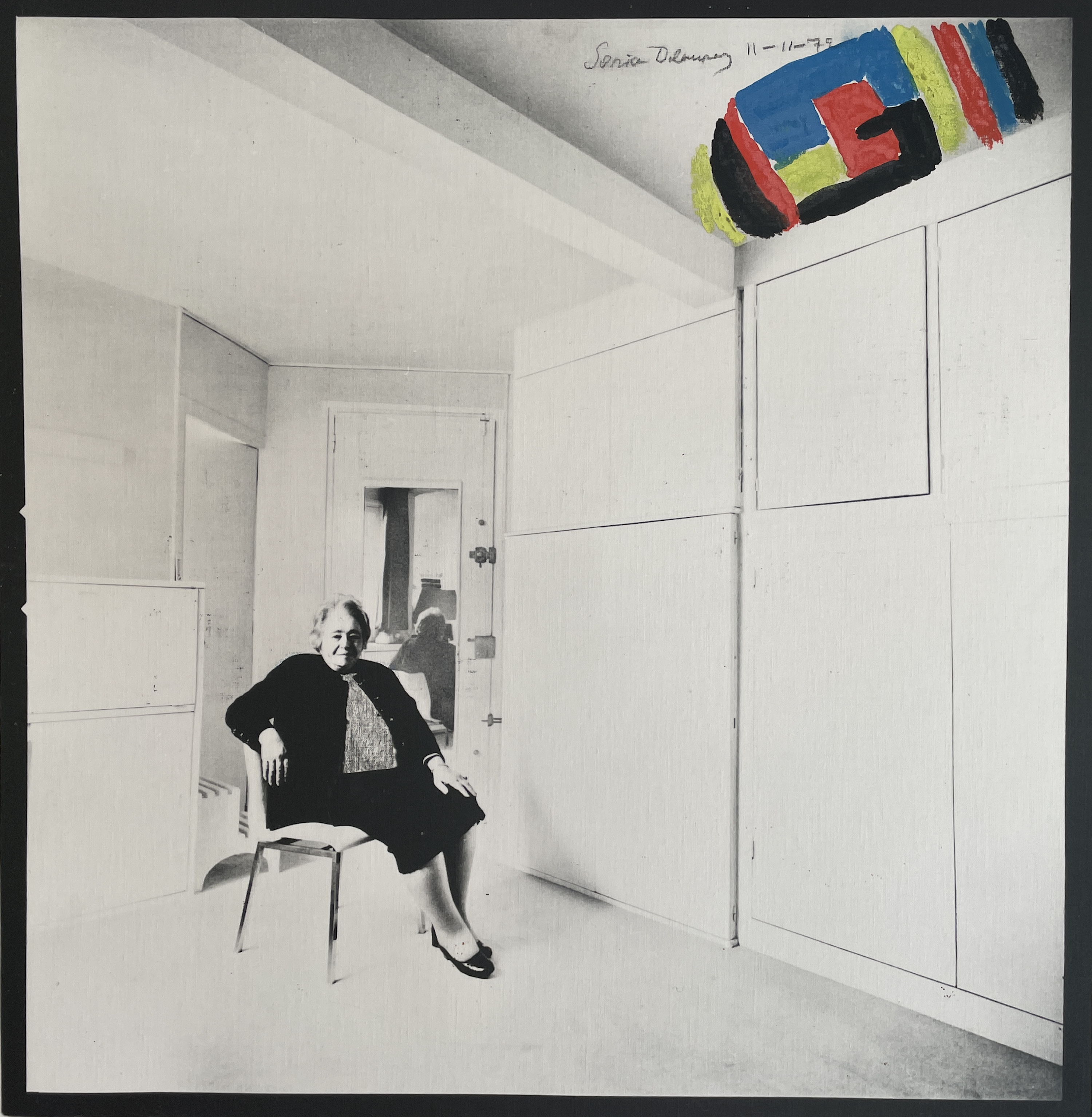
Unlike other postwar photographs, there is almost no reference here to her work—neither easel, brushes, nor paints are visible.729 The framing provided by the large green plants typical of her studio apartment is also absent. A shadow lies across the right side of her face, while her gaze is directed toward the camera. In an intensely illuminated white room she is surrounded by nothing other than rectangular surfaces—wall cabinets (containing her works)—and her back is reflected in a mirror attached to the inside of the apartment door. Wolleh had originally planned to display his portraits in a “museum for eternity,” “carved into the rock on the Swedish coast, capable of surviving even an atomic war.”730 At first, however, he asked all those he photographed to intervene in their portraits themselves. Sonia Delaunay presumably complied with this request in the winter of 1975.
Distinctive concluding Point
At the upper right of the image appears her own contribution, dated in her own hand November 11, 1975—thus coinciding with the French national day of the Jour de l’Armistice, commemorating the armistice and the end of the First World War. She chose a small format, thereby respecting Wolleh’s photograph and integrating her work into the surrounding architecture. Like a small flag—or a colorful kite?—this black, red, lime-green, and blue signature of her own art dominates the modern white space. Here the strict black-and-white is broken by the signature, the date, and the hand-painted addition, and the white-cube effect is playfully and slightly ironically undermined by a small colored kite. Shortly before her death, this portrait photograph—taken by Lothar Wolleh, a German photographer with a Russian past—sets a special accent and a distinctive concluding point in a long dialogue with border crossers in art and in life.
726 See the notes by Sonia Delaunay’s secretary in the diary entry of 1 February 1973 (DEL 211).
727 After his return from the Soviet Union, Wolleh studied photography at the Folkwang School in Essen under Otto Steinert, a leading figure in experimental portrait photography. For this and other information, I would like to thank Oliver Wolleh.
728 Wuchold 2021, o.S
729 The artist’s late photographic stagings were examined by Montfort-Tanguy in 2022.
730 Wuchold 2021, o.S.
The Text by Margarete Zimmermann was taken from:
Margarete Zimmermann, „Sonia Delaunay: Kunst und Mode im Zeichen von Emigration und Exil“ Reimer Verlag, 2025. 380 Seiten, S. 298 - 301.
Translation to English by Lothar Wolleh Estate.