- Author Oliver Wolleh
- Date 2025
The Vorkuta camp is considered one of the harshest forced labor camps of the Soviet GULag system. Lothar Wolleh was deported there in 1950 at the age of 20 and sentenced to work in the coal mines. Sixty-six years later, his son will write down his memories for the portal Workuta.de, which documents the fate of German GULag prisoners.
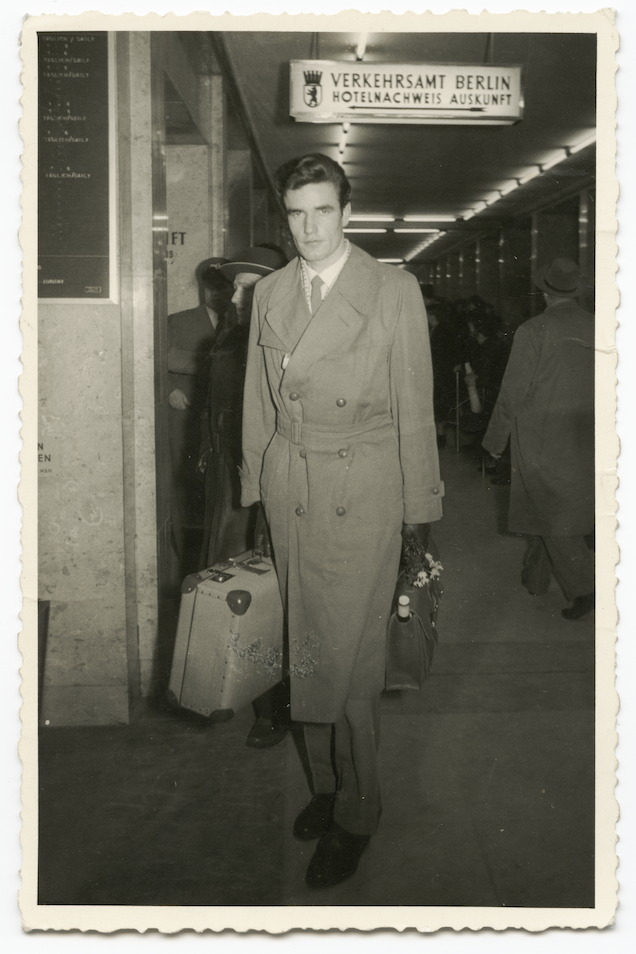
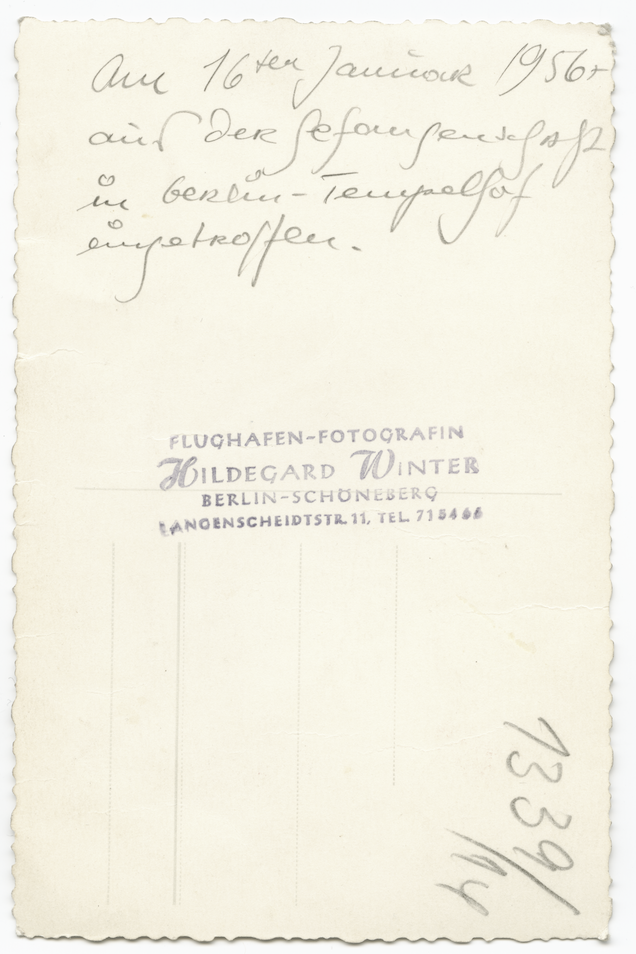
Stories about Vorkuta have been familiar to me since my earliest youth. For as long as I can remember, this bitterly cold place by the Arctic Ocean, where the night seemed never-ending, has been a part of my consciousness. In darkness, you descend into the freezing coal mine, and in darkness, you return from it. A place of immense harshness, where even the beauty of the northern lights can be found—a place of distrust and great solidarity.
My father died a few days after my 14th birthday. When I learned of his death, one of my first thoughts was: "He survived Vorkuta; how can he now simply die?" By normal standards, we did not have much time together, and yet Vorkuta runs like a red thread through my memories of him. His goal was to prepare me for all the contingencies of life, and for him, that meant instilling in me what could happen in a place like Vorkuta and how to survive a gulag.
And so I learned how to steal bread—that the art lies in throwing it unnoticed during loading so that it pierces the snow cover—and how to secretly retrieve the frozen loot at night. I learned where to strike a man with a single punch to incapacitate him and that, in moments of doubt, one should always "strike first, ask later." That pride can be deadly. That pity is a luxury. That only the strongest survive. That only your own life matters, and others’ do not.
Vorkuta could infiltrate any conceivable everyday situation, even though we lived on the entire fourth floor of a penthouse in Düsseldorf. Grief over a deceased pet could quickly lead to my father's angry outbursts. How many people had he seen die in Vorkuta. No one needs to cry over a dead rabbit. A punishment could strike me in an instant because I had sat with my back to a door. It was therefore not surprising that my father had engraved his prisoner number into the flashlight he once gave me for Christmas. The boys at the boarding school were astonished. It was not just a flashlight to read under the blanket at night. It was a "lightsaber" with eight batteries, powerful enough to illuminate trees 100 meters away from the house at night. And in case one of my boarding schoolmates tried to steal it, I could always prove that flashlight no. 083341 belonged to me.
My father rarely spoke about the man who had denounced him to the Soviets and delivered him to that man-eating machinery. I know he swore for years to survive the gulag only to kill him afterward. When my father was released, he searched for and found that man, but thankfully, he did not kill him. I have known this for 40 years, and I also know today that this man lived to be very old.
When I was ten, my mother asked me if I would like to attend a boarding school in Bonn-Bad Godesberg. It was a very good school, she explained, and besides, it would do me good if my father could not tell me so many stories about Vorkuta anymore.
Also a Place of Light
Despite all the hardships, Vorkuta was also a place of light and humanity. My father often told me about the northern lights and how the prisoners had built a camera in the camp. As a child, this seemed utterly fantastic to me. Today, these images are the oldest negatives and photographs in the estate of the photographer Lothar Wolleh. In critical moments, my father also experienced great humanity in Vorkuta. His comrades rescued him from a collapsed mine shaft, and someone even fetched "medicine from Moscow" to treat a severe illness. It was like a miracle. I believe this is the reason why, as early as the late 1960s, he traveled to the Soviet Union and published the photo book USSR – The Soviet State and Its People.
The stories about Vorkuta were never told chronologically. Thus, the tales of the punishment cell merged with accounts of the torture following his arrest and the traumas of the bombing war and the final battle in Berlin. It was only much later that I managed to organize the events in their historical sequence.
After my father’s death in 1979, I had little reason to think about Vorkuta for a long time. This changed in the early 1990s when I met participants from Russia at an international conference. One evening, over a glass of wine, I asked one of them if he knew anything about Vorkuta. He paused for a moment and then answered with a slight smile: "Nobody knows anything about Vorkuta."I asked if he might know someone who had been in Vorkuta, and he replied, "Nobody has ever been to Vorkuta." And because I still didn’t quite grasp it, I asked one more time: "Would you ever consider traveling to Vorkuta?" and he replied: "Nobody wants to go to Vorkuta."
The article was originally written for the website:
Workuta, Biografien deutscher GULag-Häftlinge
https://workuta.de/Lothar_Wolleh/biografisches.html