This exhibition is in the spirit of Lothar Wolleh's support and belief in emerging artists, and an ode to the uniting force of art. It creates a collaborative space for artistic dialogue and exchange, exhibiting young contemporary artists with formative figures of the art world.
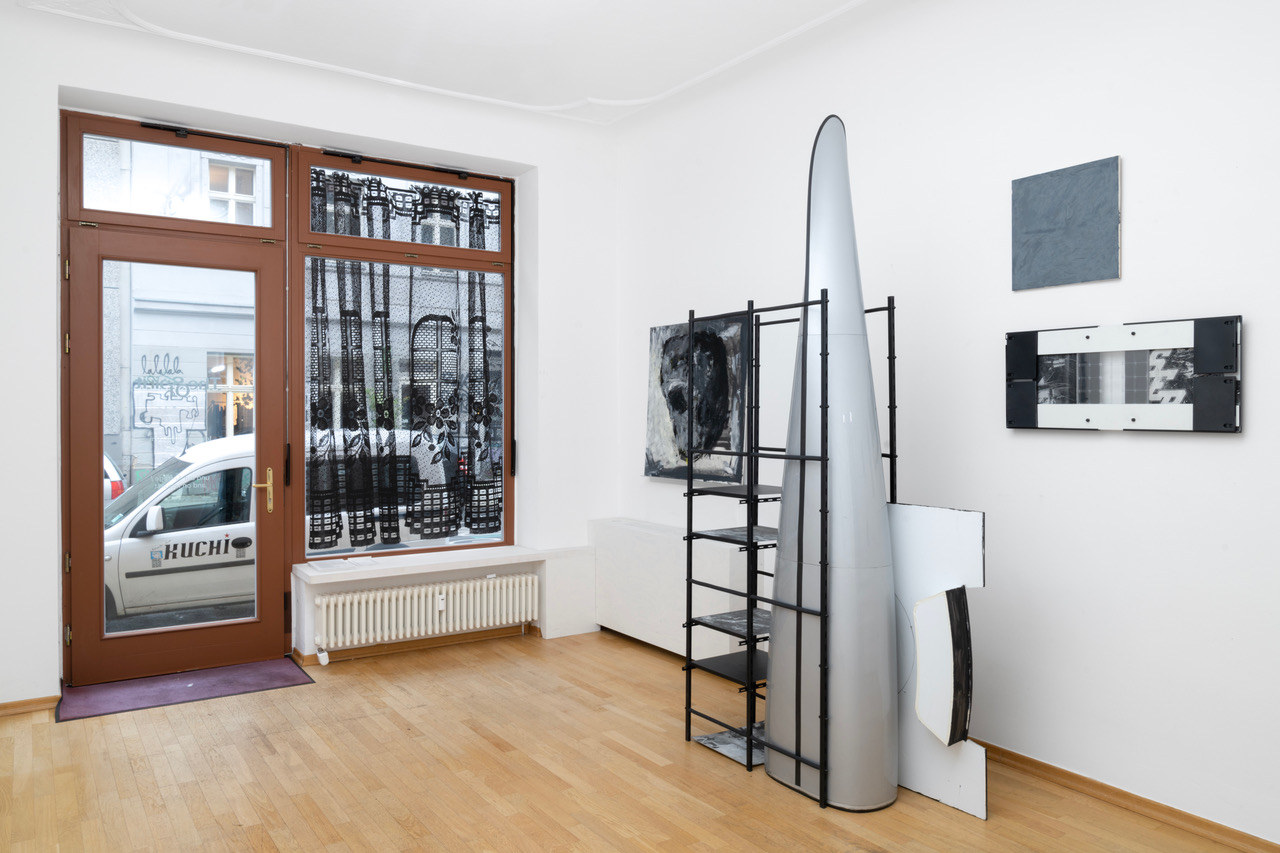
Gerhard Richters gray paintings refer to a lack of statement, a key trait in Richter’s oeuvre. “I cannot imagine a color with less meaning,” Richter reiterates. For him, these paintings represent a new way to achieve an artistic connection through absolute simplicity, creating space for the viewer to develop a newfound sensitivity.
Material that presupposes further versions
Jonathan Joosten centralizes the idea of actuality in his recent works, and how this creates an ever-changing sense of relevancy. He builds constructions to deal with material that presupposes further versions and therefore overwrites its own status. With an interest in the limitless urge for innovation, Joosten uses the kayak prototype. This phenomenon is explored further by his use of magazines and their placement within metal frames. The process of pre-archiving poses the question of how to approach the cycle of production.
Fear of death
After Wolleh´s death, Georg Baselitz painted a monumental black skull over a photograph Wolleh had taken of him in 1969. This memento mori and homage to life is further developed by Oskar Taifun Helmbold in his painting Der schöne Bulle. Helmbold depicts the fear of death within the bull, which was bred with the intention of being killed. Confronted with mortality and existential reflection the bull experiences one final moment of earthly beauty.
Dorothy Iannone expresses feminism through the representation of dominant female sexuality without taboos. Iannone´s work At Home displays herself and her partner Dieter Roth in their home in Düsseldorf exploring erotic desires, rejecting the socially accepted depiction of a woman’s home life in the 1960ties. June Mayer creates a dialogue with Iannone in a contemporary painting that represents free sexuality and united liberation. Mayer celebrates what Iannone was once censored for, paying tribute to her artistic advances. However, Mayers work serves as a testimony that feminist art still contributes to addressing social, political, and cultural issues.
Theme of birth & transformation of dimensions
Joseph Beuys frames hare blood inside plastic pouches in the exhibited work Hasenblut. According to Beuys, the hare, and its blood symbolize the menstrual cycle, birth, and “all chemical transformations of blood”. Gianna Kay explores the theme of birth; furthermore the duplexity of creation and the creator within her sculptures. Kay uses embryotic pairs to discuss the act of emersion and transformation, visualizing duality.
Kaiwen Wu´s window installation functions as a tent around the exhibition. Wu utilizes sunlight to transform a two-dimensional object into a three-dimensional installation, while the shadows constantly change the perception of the room. The shadows fluctuate depending on the lighting conditions, exploring concepts of external influences and transformation.
Curated by Magdalena Wolleh